Solanum dulcamara is a species of vine in the potato genus Solanum, family Solanaceae. Common names include bittersweet, bittersweet nightshade, bitter nightshade, blue bindweed, Amara Dulcis,[3] climbing nightshade,[4] fellenwort, felonwood, poisonberry, poisonflower, scarlet berry, snakeberry,[5][6][7] trailing bittersweet, trailing nightshade, violet bloom, and woody nightshade.

It is native to Europe and Asia, and widely naturalised elsewhere, including North America, where it is an invasive problem weed.
Overview
It occurs in a very wide range of habitats, from woodlands to scrubland, hedges and marshes.
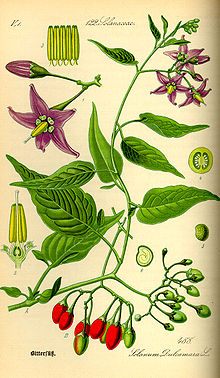
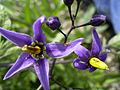
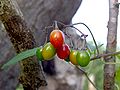
Bittersweet is a very woody herbaceous perennial vine, which scrambles over other plants, capable of reaching a height of 4 m where suitable support is available, but more often 1–2 m high. The leaves are 4–12 cm long, roughly arrowhead-shaped, and often lobed at the base. The flowers are in loose clusters of 3–20, 1–1.5 cm across, star-shaped, with five purple petals and yellow stamens and style pointing forward. The fruit is an ovoid red berry about 1 cm long,[8] soft and juicy, with the aspect and odour of a tiny tomato, and edible for some birds, which disperse the seeds widely.[citation needed] However, the berry is poisonous to humans and livestock,[9][10] and the berry's attractive and familiar look make it dangerous for children.

It is native to northern Africa, Europe, and Asia, but has spread throughout the world. The plant is relatively important in the diet of some species of birds such as European thrushes,[citation needed] which feed on its fruits, being immune to its poisons, and scatter the seeds abroad. It grows in all types of terrain with a preference for wetlands[citation needed] and the understory of riparian forests. Along with other climbers, it creates a dark and impenetrable shelter for varied animals. The plant grows well in dark areas in places where it can receive the light of morning or afternoon. An area receiving bright light for many hours reduces their development.[citation needed] It grows more easily in rich wet soils with plenty of nitrogen.
It is an nonnative species in the United States.[11]
History
Solanum dulcamara has been valued by herbalists since ancient Greek times. In the Middle Ages the plant was thought to be effective against witchcraft, and was sometimes hung around the neck of cattle to protect them from the "evil eye".[12][13][14]
John Gerard's Herball (1597) states that "the juice is good for those that have fallen from high places, and have been thereby bruised or beaten, for it is thought to dissolve blood congealed or cluttered anywhere in the intrals and to heale the hurt places."[14]
Biological activity
The stems are approved by the German Commission E for external use as supportive therapy in chronic eczema.[15]
The alkaloids, solanine (from unripe fruits), solasodine (from flowers) and beta-solamarine (from roots) inhibited the growth of E. coli and S. aureus.[16] Solanine and solasodine extracted from Solanum dulcamara showed antidermatophytic activity against Chrysosporium indicum, Trichophyton mentagrophytes and T. simil, thus it may cure ringworm.[17]
Although fatal human poisonings are rare, several cases have been documented. The poison is believed to be solanine.[18]
Gallery


| This article uses material from the Wikipedia article Metasyntactic variable, which is released under the Creative Commons Attribution-ShareAlike 3.0 Unported License. |