Senecio /sɪˈniːʃi.oʊ/[2] is a genus of the daisy family (Asteraceae) that includes ragworts and groundsels. The scientific Latin genus name, Senecio, means "old man."
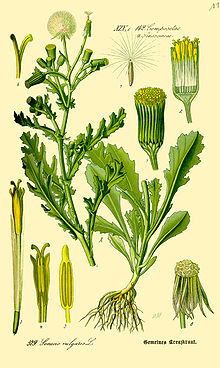

Variously circumscribed taxonomically, the genus Senecio is one of the largest genera of flowering plants. The traditional circumscription of Senecio is artificial, being polyphyletic, even in its new circumscription which is based on genetic data.[3][4] Despite the separation of many species into other genera, the genus still contains c. 1,250 species and is one of the largest genera of flowering plants.[5] As no morphological synapomorphies are known to determine which species belong to the genus or not, no exact species number is known. The genus has an almost worldwide distribution[3] and evolved in the mid- to late Miocene.[6]
Some species produce natural biocides (especially alkaloids) to deter or even kill animals that would eat them.
Senecio species are used as food plants by the larvae of some Lepidoptera species — see list of Lepidoptera that feed on Senecio. Pyrrolizidine alkaloids have been found in Senecio nemorensis[7] and in Senecio cannabifolius var. integrilifolius.[8]
Morphology
The flower heads are normally rayed with the heads borne in branched clusters, and usually completely yellow, but green, purple, white and blue flowers are known as well.
In its current circumscription, the genus contains species that are annual or perennial herbs, shrubs, small trees, aquatics or climbers. The only species which are trees are the species formerly belonging to Robinsonia occurring on the Juan Fernández Islands.[9]
Distribution
The genus Senecio is distributed almost worldwide.[3] It is one of the few genera occurring in all five regions with a Mediterranean climate. Furthermore, species are found in mountainous regions, including tropical alpine-like areas.
Phylogeny
Many genera and the whole tribe are in need of revision. Many species currently placed in the genus need to be transferred to other or new genera, and others have been retransferred to Senecio. In its new delimitation the genus is still not monophyletic.[3]
Genera that have been included are the following:[3]
- Aetheolaena
- Culcitum
- Hasteola
- Iocenes B. Nord.
- Lasiocephalus Willd. ex Schltdl.
- Robinsonia
Synonyms

The following genera contain species that are or have been included within Senecio.[3]
- Antillanthus B. Nord.
- Barkleyanthus H. Rob. & Brettell
- Brachyglottis J. R. Forst. & G. Forst.[10]
- Canariothamnus B. Nord.
- Curio P.V. Heath
- Dauresia B. Nord. & Pelser
- Dendrophorbium C. Jeffrey
- Dendrosenecio (Hauman ex Hedberg) B. Nord. - Giant groundsels occurring in the high altitude areas of East Africa
- Dorobaea Cass.
- Dresslerothamnus H. Rob.
- Elekmania B. Nord.
- Herreranthus B. Nord.
- Hubertia Bory
- Jacobaea Mill.Leonis B. Nord.
- Ligularia
- Lundinia B. Nord.
- Mesogramma DC.
- Monticalia C. Jeffrey
- Nelsonianthus H. Rob. & Brettell
- Nesampelos B. Nord., nom. inval.
- Oldfeltia B. Nord. & Lundin
- Packera Á. Löve & D. Löve
- Pentacalia Cass.
- Pippenalia McVaugh
- Pittocaulon H. Rob. & Brettell
- Pojarkovia Askerova
- Psacaliopsis H. Rob. & Brettell
- Pseudogynoxys (Greenm.) Cabrera
- Pseudojacobaea (Hook. f.) R. Mathur
- Roldana La Llave
- Sinosenecio B. Nord.
- Synotis (C. B. Clarke) C. Jeffrey & Y. L. Chen
- Telanthophora H. Rob. & Brettell
- Tephroseris (Rchb.) Rchb.
- Vendredia Baill.[1]
- Zemisia B. Nord.[1]
Selected species


- Senecio ampullaceus — Texas ragwort, Texas squaw-weed, Texas groundsel, clasping-leaf groundsel[11]
- Senecio angulatus L.f. — creeping groundsel
- Senecio antisanae
- Senecio arborescens’'
- Senecio barbertonicus Klatt — succulent bush senecio
- Senecio battiscombei
- Dendrosenecio battiscombei
- Senecio bigelovii — nodding groundsel
- Senecio bosniacus G. Beck — Bosnian ragwort
- Senecio brasiliensis (Spreng.) Less. — flor-das-almas
- Cineraria brasiliensis
- Senecio candicans — angel wings
- Senecio cambrensis — Welsh groundsel, Welsh ragwort
- Senecio congestus (R. Br.) DC. — marsh ragwort, clustered marsh ragwort, marsh fleabane
- Cineraria palustris
- Othonna palustris
- Tephroseris palustris
- Senecio crassissimus
- Senecio douglasii — threadleaf groundsel
- Senecio elegans — purple groundsel
- Senecio flaccidus Less. — Douglas senecio, threadleaf groundsel, threadleaf ragwort
- Senecio ficoides
- Curio ficoides
- Senecio gallicus Chaix — French groundsel
- Senecio glabellus Poir. — butterweed
- Packera glabella (Poir) C. Jeffrey
- Senecio glaucus L. — Jaffa groundsel
- Senecio haworthii — woolly senecio
- Senecio 'Hippogriff' — dolphin necklace, flying dolphins, dolphin plant
- Curio × peregrinus
- Senecio howeanus
- Senecio inaequidens — South African ragwort
- Senecio iscoensis — Hieron.
- Senecio jacobaea — is a synonym of Jacobaea vulgaris.
- Senecio keniensis
- Dendrosenecio keniensis
- Senecio keniodendron — giant groundsel
- Dendrosenecio keniodendron
- Senecio keniophytum
- Senecio kleinia
- Kleinia neriifolia
- Senecio kleiniiformis — spearhead
- Senecio lamarckianus
- Senecio leucanthemifolius Poir. — coastal ragwort
- Senecio littoralis
- Senecio madagascariensis — Madagascar ragwort
- Senecio macroglossus — Natal ivy, wax ivy
- Senecio mikanioides — Cape ivy, German ivy
- Delairea odorata
- Senecio neowbsteri Olympic Mountain groundsel
- Senecio nivalis Kunth
- Senecio obovatus Muhl. — roundleaf ragwort
- Packera obovata (Muhl. ex Willd.)
- Senecio patagonicus
- Senecio pauciradiatus
- Senecio pulcher
- Senecio radicans — string of bananas
- Curio radicans
- Senecio rowleyanus — string of pearls
- Curio rowleyanus
- Senecio sanmarcosensis
- Senecio scandens — German ivy[12][13]
- Senecio serpens — blue chalksticks
- Curio repens
- Senecio squalidus — Oxford ragwort
- Senecio trapezuntinus
- Senecio triangularis — arrowleaf groundsel
- Senecio vaginatus
- Senecio vernalis — eastern groundsel
- Senecio viscosus — sticky ragwort
- Senecio vulgaris — common groundsel, old-man-in-the-spring
Formerly in Senecio
- Brachyglottis greyi (as S. greyi)
- Florist's Cineraria, Pericallis × hybrida (as S. cruentus)
- Rugelia nudicaulis — Rugels ragwort
| This article uses material from the Wikipedia article Metasyntactic variable, which is released under the Creative Commons Attribution-ShareAlike 3.0 Unported License. |