Pseudofumaria lutea (syn. Corydalis lutea), the yellow corydalis or rock fumewort,[3] is a short-lived perennial plant in the poppy family Papaveraceae. It is native to the southern foothills of the south-western and central Alps of Italy and Switzerland, but widely introduced elsewhere.


Characteristics
Yellow corydalis grows to 30–38 cm (12–15 in) tall. Leaves are finely divided and yellow-green to gray-green, often remaining over winter.
Flowers are 2 centimetres (0.75 in) long, borne in racemes on short, branched, leafy stems from late spring to autumn. They have 4 petals; the top and bottom ones crested, the top one with a short, rounded spur curved downwards, the 2 inner ones connected at the tip.
Its seeds, dark brown with white elaiosomes, are held in oval, flat pods. Plants self-seed abundantly.
Cultivation
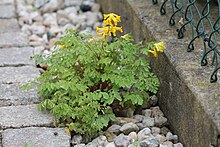
Yellow corydalis is hardy to –34 °C (-30 °F; hardiness zone 4). It does best in light shade with good moisture, but will tolerate both full sun and deep shade. It grows wild in cracks in old walls where drainage is excellent.
| This article uses material from the Wikipedia article Metasyntactic variable, which is released under the Creative Commons Attribution-ShareAlike 3.0 Unported License. |