Ligustrum vulgare (wild privet, also sometimes known as common privet or European privet) is a species of Ligustrum native to central and southern Europe, north Africa and southwestern Asia, from Ireland and southwestern Sweden south to Morocco, and east to Poland and northwestern Iran.[1][2][3][4][5]

Description
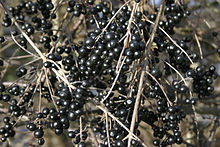
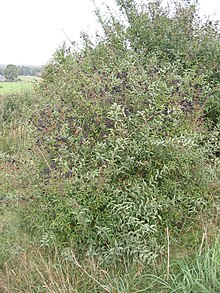
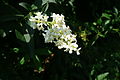
It is a semi-evergreen or deciduous shrub, growing to 3 m (rarely up to 5 m) tall. The stems are stiff, erect, with grey-brown bark spotted with small brown lenticels. The leaves are borne in decussate opposite pairs, sub-shiny green, narrow oval to lanceolate, 2–6 cm long and 0.5–1.5 cm broad. The flowers are produced in mid-summer in panicles 3–6 cm long, each flower creamy-white, with a tubular base and a four-lobed corolla ('petals') 4–6 mm diameter. The flowers produce a strong, pungent fragrance that many people find unpleasant. The fruit is a small glossy black berry 6–8 mm diameter, containing one to four seeds. The berries are poisonous to humans but readily eaten by thrushes, which disperse the seeds in their droppings.[4][5][6]
Plants from the warmer parts of the range show a stronger tendency to be fully evergreen; these have sometimes been treated as a separate variety Ligustrum vulgare var. italicum (Mill.) Vahl,[5] but others do not regard it as distinct.[1]
Cultivation and uses
In the British Isles it is the only native privet, common in hedgerows and woodlands in southern England and Wales, especially in chalk areas; it is less common in northern England, Scotland, and Northern Ireland, where it only occurs as an escape from cultivation.[5][7][8]
The species was used for hedging in Elizabethan gardens in England, but was superseded by the more reliably evergreen introduction L. ovalifolium from Japan.[7]
A number of cultivars have been selected, including:[5]
- 'Aureum' – yellow leaves.
- 'Buxifolium' – small, oval leaves not over 2.5 cm long.
- 'Cheyenne' – cold-tolerant clone selected in North America.
- 'Chlorocarpum' - berries green.
- 'Insulense' – long, narrow leaves 5–11 cm long and 1-2.5 cm broad.
- 'Leucocarpum' – berries greenish-white.
- 'Lodense' – dense, dwarf shrub (the name is a portmanteau of 'low' and 'dense').
- 'Pyramidale' – fastigiate.
- 'Xanthocarpum' – berries yellow.
Invasiveness
The species is listed as invasive as an introduced plant in Australia,[9] Canada,[10] New Zealand,[11] and the United States.[12][13] It is also fully naturalised in Mexico's highlands[14] and Argentina.[15]
Etymology
Ligustrum means ‘binder’. It was named by Pliny and Virgil.[16]
Gallery



| This article uses material from the Wikipedia article Metasyntactic variable, which is released under the Creative Commons Attribution-ShareAlike 3.0 Unported License. |