Ligustrum sinense (Chinese privet;[1] syn. L. villosum; in Mandarin: 杻; pinyin: chǒu) is a species of privet native to China, Taiwan and Vietnam,[2] and naturalized in Réunion, the Andaman Islands, Norfolk Island, Costa Rica, Honduras, Panamá and much of the eastern and southern United States (from Texas and Florida north to Kansas, Illinois, New Jersey, Massachusetts and Connecticut).[3][4] The name "Chinese privet" may also refer to Ligustrum lucidum.[5]

Description
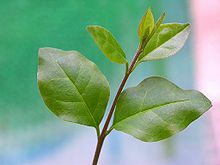
Ligustrum sinense is a deciduous shrub growing to 2–7 m tall, with densely hairy shoots. The leaves are opposite, 2–7 cm long and 1–3 cm broad, rarely larger, with an entire margin and a 2–8 mm petiole. The flowers are white, with a four-lobed corolla 3.5–5.5 mm long. The fruit is subglobose, 5–8 mm diameter,[2][6] and considered poisonous.[7]
Varieties
The following varieties are accepted by the Flora of China:[2]
- Ligustrum sinense var. sinense
- Ligustrum sinense var. concavum M.C.Chang
- Ligustrum sinense var. coryanum (W.W.Sm.) Hand.-Mazz.
- Ligustrum sinense var. dissimile S.J.Hao
- Ligustrum sinense var. luodianense M.C.Chang
- Ligustrum sinense var. myrianthum (Diels) Hoefker
- Ligustrum sinense var. opienense Y.C.Yang
- Ligustrum sinense var. rugosulum (W.W.Sm.) M.C.Chang
Cultivation and uses

It is cultivated as an ornamental plant and for hedges. Several cultivars have been selected, including the very floriferous 'Multiflorum', the variegated cultivar 'Variegatum', and the dwarf cultivar 'Wimbei' growing to 0.5 m and with leaves only 6 mm long.[8]
It was introduced to North America to be used for hedges and landscaping where it has now escaped from cultivation and is listed as an invasive plant in southeastern states.[1][9] It is estimated that Chinese privet now occupies over one million hectares of land across 12 states ranging from Virginia to Florida and west to Texas, with detrimental effects to biodiversity and forest health.[10]
Etymology
Ligustrum means 'binder'. It was named by Pliny and Virgil.[11]
| This article uses material from the Wikipedia article Metasyntactic variable, which is released under the Creative Commons Attribution-ShareAlike 3.0 Unported License. |