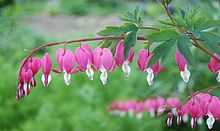
Lamprocapnos spectabilis, bleeding heart or Asian bleeding-heart,[2] is a species of flowering plant in the poppy family Papaveraceae, native to Siberia, northern China, Korea and Japan. It is the sole species in the monotypic genus Lamprocapnos, but is still widely referenced under its old name Dicentra spectabilis (now listed as a synonym). It is valued in gardens and in floristry for its heart-shaped pink and white flowers, borne in spring.[3]

Other common names include lyre flower, heart flower and lady-in-a-bath.[citation needed]
Description

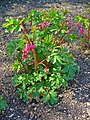
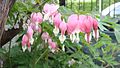
The Asian bleeding-heart grows to 120 cm (47 in) tall by 45 cm (18 in) wide. It is a rhizomatous herbaceous perennial with 3-lobed compound leaves on fleshy green to pink stems. The arching horizontal racemes of up to 20 pendent flowers are borne in spring and early summer. The outer petals are bright fuchsia-pink, while the inner ones are white. The flowers strikingly resemble the conventional heart shape, with a droplet beneath – hence the common name. The plant sometimes behaves as a spring ephemeral, going dormant in summer.[3]

History
The first specimens were introduced to England from Asia in the 1840s by the Scottish botanist and plant hunter Robert Fortune.[4]
Cultivation
In a moist and cool climate, it will grow in full sun, but in warmer and drier climates it requires some shade.
Aphids, slugs and snails sometimes feed on the leaves.
Clumps remain compact for many years and do not need dividing. They have brittle roots which are easily damaged when disturbed. Root cuttings should be taken in spring.[5]
Seeds with whitish elaiosomes are borne in long pods. They must be sown while fresh. Division should be done in the late fall (autumn) or early spring.
Cultivars
The following have gained the Royal Horticultural Society's Award of Garden Merit:-[6]
- Lamprocapnos spectabilis[7] (pink and white)
- 'Alba'[8] (white)
- "Valentine" ('Hordival')[9] (red and white)
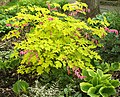
'Gold Heart', introduced from Hadspen Garden, England, in 1997,[4] has yellow leaves.
Toxins
Contact with the plant can cause skin irritation in some people from isoquinoline-like alkaloids.[10][11]
Gallery

| This article uses material from the Wikipedia article Metasyntactic variable, which is released under the Creative Commons Attribution-ShareAlike 3.0 Unported License. |