Kalmia angustifolia is a flowering shrub in the family Ericaceae, commonly known as sheep laurel. It is distributed in eastern North America from Ontario and Quebec south to Virginia.[1] It grows commonly in dry habitats in the boreal forest, and may become dominant over large areas after fire or logging.[2] Like many plant species of infertile habitats it has evergreen leaves and mycorrhizal associations with fungi.[3] It is also found in drier area of peat bogs.

Description
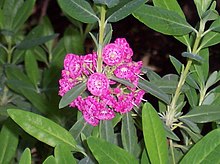
The attractive small, deep crimson-pink flowers are produced in early summer. Each has five sepals, with a corolla of five fused petals, and ten stamens fused to the corolla. They are pollinated by bumble bees and solitary bees. Each mature capsule contains about 180 seeds.[4]
In the wild the plant may vary in height from 15–90 cm (6–35 in). New shoots arise from dormant buds on buried rhizomes. This process is stimulated by fire.[4] The narrow evergreen leaves, pale on the underside, have a tendency to emerge from the stem in groups of three. The Latin specific epithet angustifolia means "narrow-leaved".[5] A peculiarity of the plant is that clusters of leaves usually terminate the woody stem, for the flowers grow in whorls or in clusters below the stem apex.[6]
Cultivation

Kalmia angustifolia is cultivated as an ornamental garden shrub. It prefers a moist, acidic soil in partial shade. The species has gained the Royal Horticultural Society's Award of Garden Merit.[7] Numerous cultivars have been selected for garden use, of which K. angustifolia f. rubra,[8] with rich red flowers, has also won the award.[9]
Toxicity
Kalmia contains a glycoside, known as andromedotoxin.[10] It is poisonous to mammals. Hence, it can be unwelcome in pastures.[11] Several of its folk-names testify to the plant's toxicity: 'lamb-kill', 'sheep kill', 'calf-kill', 'pig laurel', 'sheep-laurel' and 'sheep-poison'.[12] It is also known as narrow-leaved laurel and dwarf laurel.[12]
| This article uses material from the Wikipedia article Metasyntactic variable, which is released under the Creative Commons Attribution-ShareAlike 3.0 Unported License. |