Fritillaria imperialis, the crown imperial, imperial fritillary or Kaiser's crown, is a species of flowering plant in the lily family, native to a wide stretch from the Anatolian plateau of Turkey, Iraq and Iran to Afghanistan, Pakistan, Northern India and the Himalayan foothills.[2] It is also widely cultivated as an ornamental and reportedly naturalized in Austria, Sicily, and Washington State, USA.[3][2][4] The common names and also the epithet "imperialis", literally "of the emperor", refer to the large circle of golden flowers, reminiscent of an emperor's crown.[5]


Description
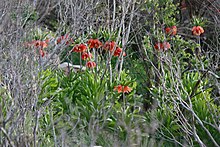
Fritillaria imperialis grows to about 1 m (3 ft) in height, and bears lance-shaped, glossy leaves at intervals along the stem. It bears a prominent whorl of downward facing flowers at the top of the stem, topped by a 'crown' of small leaves, hence the name. While the wild form is usually orange-red, various colours are found in cultivation, ranging from nearly a true scarlet through oranges to yellow. The pendulous flowers make a bold statement in the late spring garden; in the northern hemisphere, flowering takes place in late spring, accompanied by a distinctly foxy odour that repels mice, moles and other small animals.[5][6]
Cultivation
Due to the way that the bulb is formed, with the stem emerging from a depression, it is best to plant it on its side, to prevent water causing rot at the top of the bulb.[7] Fritillaria imperialis requires full sun for best growth, and sandy, well-drained soil for permanence. After flowering and complete drying of the leaves, the stems should be cut off just above the ground.
The species[8] and the yellow-flowered 'Maximea Lutea' [9] have both gained the Royal Horticultural Society's Award of Garden Merit.[10] Other cultivars in shades of red, yellow and orange, are available.
Like other members of the lily family, F. imperialis is susceptible to depredation by the scarlet lily beetle (Lilioceris lilii).[5]
Taxonomy
A few names have been coined for taxa once considered as belonging to Fritillaria imperialis but now regarded as distinct species:
- Fritillaria imperialis var. chitralensis, now called Fritillaria chitralensis
- Fritillaria imperialis var. eduardii, now called Fritillaria eduardii
- Fritillaria imperialis var. inodora, now called Fritillaria eduardii var. inodora
- Fritillaria imperialis var. inodora-purpurea, now called Fritillaria eduardii var. eduardii

Gallery


| This article uses material from the Wikipedia article Metasyntactic variable, which is released under the Creative Commons Attribution-ShareAlike 3.0 Unported License. |