Euonymus

 Euonymus /jˈɒnɪməs/ is a genus of flowering plants in the staff vine family, Celastraceae. Common names vary widely among different species and between different English-speaking countries, but include spindle (or spindle tree), burning-bush, strawberry-bush, wahoo, wintercreeper, or simply euonymus. It comprises about 130 species[2][3] of deciduous and evergreen shrubs, small trees and lianas. They are mostly native to East Asia, extending to the Himalayas,[4] and they are also distributed in Europe, Australasia, North America, and Madagascar. 50 species are endemic to China.[2]
Euonymus
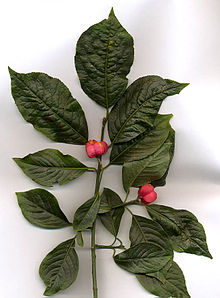
Euonymus europaeus.jpg
Euonymus europaeus foliage and fruit
Scientific classificatione
Kingdom:Plantae
Clade:Tracheophytes
Clade:Angiosperms
Clade:Eudicots
Clade:Rosids
Order:Celastrales
Family:Celastraceae
Genus:Euonymus
L.
Species

See text

Synonyms

Kalonymus (Beck) Prokh.
Pragmotessara Pierre
Pragmotropa Pierre
Quadripterygium Tardieu
Sphaerodiscus Nakai[1]

DescriptionEdit

Euonymus europaeus bushes in a garden

The inconspicuous flowers occur in small groups, and can be green, yellow, pink or maroon in color depending on species.[4] The leaves are opposite (rarely alternate) and simple ovoid, typically 2–15 cm long, and usually with a finely serrated margin. The fruit is a pink or white four- or five-valved pod-like berry, which splits open to reveal the fleshy-coated orange or red seeds.

The seeds are eaten by frugivorous birds, which digest the fleshy seed coat and disperse the seeds in their droppings. Many species are used for medicinal use, and parts of the plants can be poisonous to humans.[5]

Cultivation and usesEdit

Mature spindle fruit (Euonymus sp.), split open to reveal the seeds

The wood of some species was traditionally used for the making of spindles for spinning wool;[6] this use is the origin of the British English name of the shrubs.

Euonymus are popular garden shrubs, grown for their foliage, the deciduous species often exhibiting very bright red autumnal colours, and also for the decorative berries. However, Euonymus alatus (winged euonymus or burning-bush) is considered an invasive species in the woodlands of the northeastern United States.

DiversityEdit

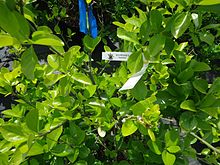
Euonymus fortunei in a nursery

Species include:[7]

  • Euonymus acanthocarpus
  • Euonymus acuminifolius[8]
  • Euonymus alatus – winged spindle, burning-bush
  • Euonymus americanus – strawberry-bush
  • Euonymus angulatus
  • Euonymus assamicus
  • Euonymus atropurpureus – eastern burning-bush, eastern wahoo
  • Euonymus bungeanus – winterberry euonymus
  • Euonymus castaneifolius[8]
  • Euonymus cochinchinensis
  • Euonymus carnosus
  • Euonymus cornutus
  • Euonymus dichotomus
  • Euonymus echinatus
  • Euonymus europaeus – European spindle
  • Euonymus fimbriatus – fringed spindle tree
  • Euonymus fortunei – Fortune's spindle, wintercreeper
  • Euonymus frigidus
  • Euonymus glandulosus
  • Euonymus grandiflorus
  • Euonymus hamiltonianus – Hamilton's spindle, Himalayan spindle
  • Euonymus japonicus – Japanese spindle, evergreen spindle
  • Euonymus javanicus
  • Euonymus kiautschovicus – spreading euonymus
  • Euonymus kwangtungensis
  • Euonymus lanceifolia
  • Euonymus latifolius – broadleaf spindle
  • Euonymus melananthus
  • Euonymus mengtzeanus[3]
  • Euonymus morrisonensis
  • Euonymus myrianthus
  • Euonymus nanoides
  • Euonymus nanus – dwarf spindle
  • Euonymus nitidus
  • Euonymus obovatus – running strawberry-bush
  • Euonymus occidentalis – western burning-bush
  • Euonymus oxyphyllus – Korean spindletree[9]
  • Euonymus pallidifolius
  • Euonymus paniculatus
  • Euonymus pauciflorus
  • Euonymus pendulus (syn. E. lucidus)
  • Euonymus phellomanus
  • Euonymus pittosporoides[10]
  • Euonymus planipes – dingle-dangle tree
  • Euonymus prismatomerioides[10]
  • Euonymus pseudovagans[3]
  • Euonymus sachalinensis
  • Euonymus sanguineus
  • Euonymus schensianus
  • Euonymus semenovii
  • Euonymus serratifolius
  • Euonymus tenuiserrata[10]
  • Euonymus thwaitesii
  • Euonymus velutinus
  • Euonymus verrucocarpa[10]
  • Euonymus verrucosoides
  • Euonymus verrucosus
  • Euonymus walkeri
  • Euonymus wui[3]

This article uses material from the Wikipedia article
 Metasyntactic variable, which is released under the 
Creative Commons
Attribution-ShareAlike 3.0 Unported License
.