Actaea pachypoda, the white baneberry or doll's-eyes, is a species of flowering plant in the genus Actaea, of the family Ranunculaceae.
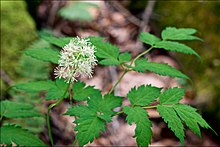

The plant is native to eastern North America, in eastern Canada, and the Midwestern and Eastern United States. It prefers clay to coarse loamy upland soils, and is found in hardwood and mixed forest stands.
Description
This herbaceous perennial plant grows to 50 cm (1.6 ft) or more tall. It has toothed, bipinnate compound leaves up to 40 cm (16 in) long and 30 cm (12 in) broad.

The white flowers are produced in spring in a dense raceme about 108 cm (43 in) long. Its most striking feature is its fruit, a 1 cm (1⁄2 in) diameter white berry, whose size, shape, and black stigma scar give the species its other common name, "doll's eyes". The pedicels on which the berries grow are thicker than those of the related species, red baneberry (Actaea rubra). This is the reason for the specific name pachypoda, which means "thick foot",[1] from Ancient Greek παχύς pakhús "thick" and πούς poús "foot". The pedicels thicken and become bright red as the berries develop.[2]
The berries ripen over the summer, turning into fruits that persists on the plant until frost.
There are pink- and red-berried plants that have been called A. pachypoda forma rubrocarpa, but some of them produce infertile seed, and may actually be hybrids with Actaea rubra.[3]
Toxins
Both the berries[4] and the entire plant are considered poisonous to humans. The berries contain cardiogenic toxins which can have an immediate sedative effect on human cardiac muscle tissue, and are the most poisonous part of the plant. Ingestion of the berries can lead to cardiac arrest and death.
The berries are harmless to birds, the plant's primary seed dispersers.
Cultivation
Actaea pachypoda is cultivated as an ornamental plant, in traditional and wildlife gardens.
It requires part or full shade, rich loamy soil, and regular water with good drainage to reproduce its native habitat.[5]
| This article uses material from the Wikipedia article Metasyntactic variable, which is released under the Creative Commons Attribution-ShareAlike 3.0 Unported License. |